
Bitcoin's Buying Zone
GFN – LONDON: Standard Chartered's global head of digital asset research told clients bitcoin's bear-market low is nearly in, maintaining a year-end target of $100,000 even as the token traded near $63,700 and tested critical support at $60,000.
The assessment came in a June 4 client note from Geoff Kendrick, who hinged the call on three conditions: a repeat of Strategy's December 2022 pattern of buying back more bitcoin than it sells, structural durability in spot ETF flows, and exhaustion of leveraged-long liquidations. Strategy sold 32 BTC between May 26 and May 31 to fund dividend obligations, and a buyback of roughly 100 times that amount, confirmable as early as the following Monday, would serve as a tentative bottom signal.
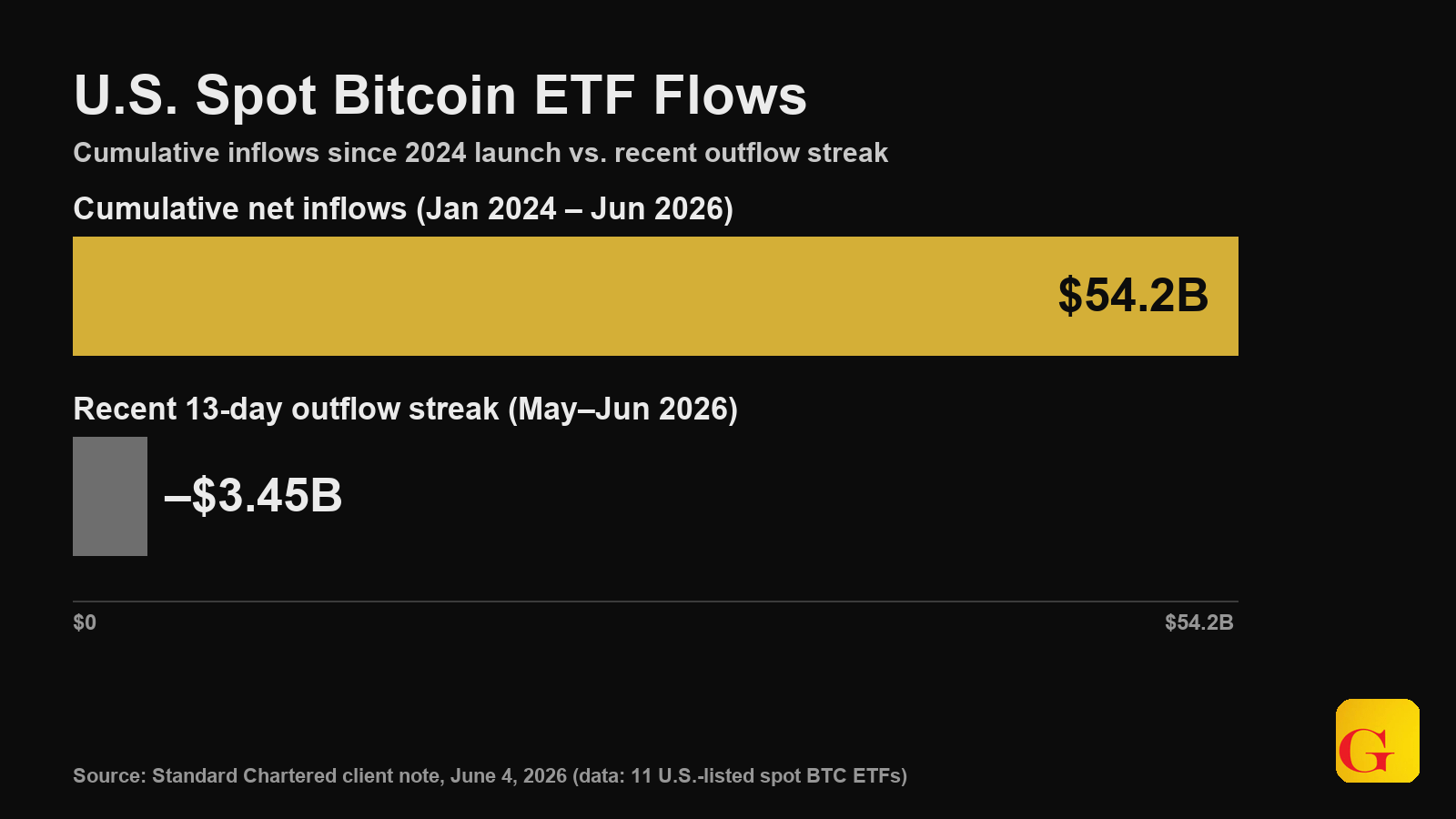
U.S.-listed spot bitcoin ETFs recorded 13 consecutive sessions of net outflows totaling about $3.45 billion, including a $1.42 billion withdrawal in the week ending May 29 and $2.30 billion across May 2026, the worst month of the year, yet cumulative net inflows since inception held at $54.2 billion and aggregate holdings stood at roughly 674,000 BTC across eleven funds. Kendrick framed that resilience as the decisive variable.
"They went up from 682k and then back down to now 674k (broadly unchanged). This tells me that ETF holdings are more structurally strong than I had feared in February," the bank wrote, according to The Block.

Futures liquidations during the current drawdown reached $1.5 billion, in line with January levels and below comparable prior episodes, leaving a thinner pool of forced sellers. Bitcoin traded near $63,739 on Wednesday, down roughly 14% over seven days and about 51% below the October 2025 all-time high of $126,277, with $60,000 the critical support level.
The call leaves a $100,000 year-end bitcoin target and a $4,000 ether target intact, framing the present sell-off as a tactical buying zone within an unchanged long-term thesis. The update aligns Standard Chartered's near-term tactical view with its broader structural positioning on digital assets as an institutional allocation.