
GFN – LONDON: LME copper reached a record $14,396 a tonne as exchange inventories fell for a 42nd consecutive session and the cash-to-three-month spread widened to its strongest backwardation since October 2021, signalling acute near-term supply tightness.
Analysts said in a commodities note that copper rose 1.7% in morning trade, extending its rally for a third session and marking a seventh consecutive week of gains. London Metal Exchange inventories stand at 204,975 tonnes, their lowest level since February, with the cash-to-three-month spread in backwardation at $518.5 a tonne.
"Continued flows to the US and China, where prices trade at premiums to the LME, have drained stocks, while nearly half of remaining inventories are already earmarked for withdrawal," the note said.
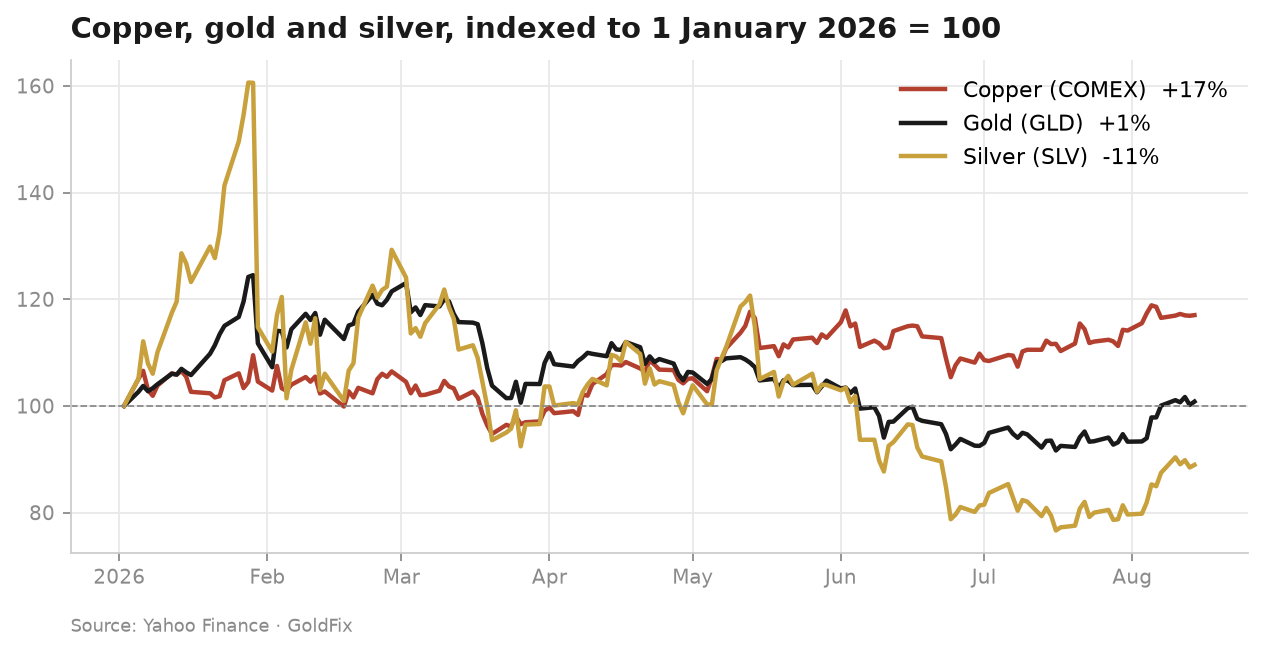
Supply expectations have tightened alongside the inventory draw. Chile's copper commission, Cochilco, expects national output to fall 2.6% year on year to 5.3 million tonnes in 2026, reflecting weaker production from Codelco and BHP operations; copper is now up around 16% year to date. Positioning has followed the physical market, with money managers raising net long COMEX copper positions by 3,084 lots to 80,880 lots, the highest since February 2021.

The build extends into precious metals, where net long COMEX gold positions rose by 9,470 lots to 141,868 lots, the highest since September 2025, while net long COMEX silver positions edged lower by 755 lots to 10,312 lots. The positioning build is therefore broad while the price action is not: copper has advanced around 16% this year, whereas gold is close to unchanged and silver is lower, leaving the industrial metal to set the pace at a point when exchange inventory cover is at its thinnest in months.
That configuration, with nearby spreads at levels last seen in the 2021 squeeze, points to physical availability rather than macro allocation as the binding constraint. The development underscores the growing weight of exchange inventory in metals pricing.
So if product availability is limited in a free market of genuine "price discovery," then how is it that middle men in finance have more influence on price than do producers and consumers of the product? If supply and demand is a true economic concept then there has to be a third operation introduced to alter the simple binary negotiation of price between the buyer and seller. There must be several "invisible hands" in play, and many of them or pick-pockets.