
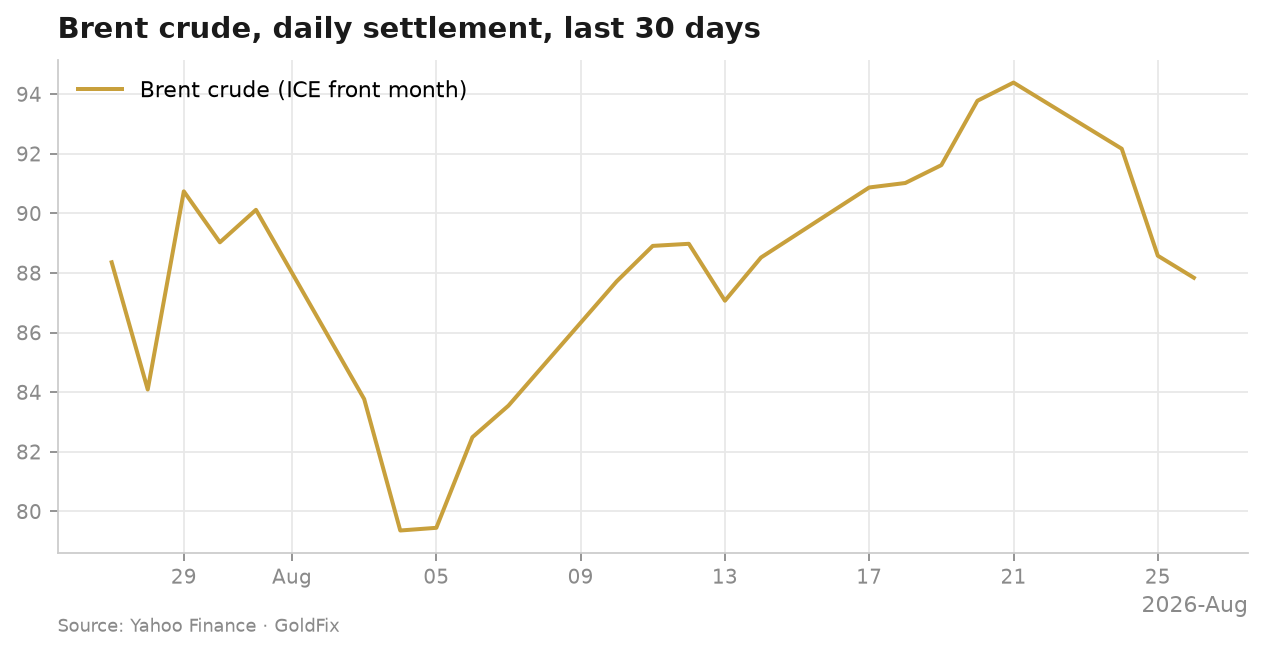
GFN – LONDON: Oil extended its decline, with Brent settling at its lowest since mid-August, as Iran and Oman moved closer to a deal on tanker routes through the Strait of Hormuz and Pakistan reported progress on ending the war.
Analysts said in a commodities note that positive signals from Persian Gulf talks appeared to be the catalyst, with Pakistani officials reporting significant progress toward ending the war after a visit to Tehran, and Iran and Oman appearing closer to an agreement on shipping routes through the strait. ICE Brent settled 3.89% lower at $88.58 on Tuesday, its first close below $90 since Aug. 14, and slipped a further 0.8% to $87.84 on Wednesday, a third consecutive decline and its lowest settlement since Aug. 13; it traded near $87 early on Thursday.
"Any agreement between these two parties does not mean we will see normalisation in oil flows through the key chokepoint," the note said. "We would likely need to see the US lift its blockade on Iranian ports and ease sanctions on Iran before we see any move towards normalisation."
Visibility on those flows is deteriorating. Tankers are increasingly transiting Hormuz with transponders switched off, just as shuttle movements carrying crude out of the Persian Gulf have picked up, and the report described oil-flow surveillance as one of the market's most critical risk metrics. The United States claims an average of 8m to 9m barrels a day is passing through the strait, while ship-tracking estimates range from 2m to around 6m b/d; the higher figure was described as achievable over short periods but aggressive over a longer horizon.

American Petroleum Institute data showed US crude inventories rose by 4.2m barrels last week while gasoline and distillate stocks fell by 3.2m and 500k barrels, and Russia, the second-largest diesel exporter, is reported to be considering extending its diesel export ban until Oct. 1 amid continued attacks on refinery infrastructure, having already extended it once to Sept. 1. The gap between official and tracked Hormuz volumes, alongside tightening middle distillate supply, underscores the weight that physical flow data continues to carry in oil market positioning as diplomatic signals shift.