

China is building the financial plumbing to connect its vast physical gold market with Hong Kong and the world, turning bullion into renminbi collateral and challenging the supremacy of US Treasuries.
Delivery Connect: Linking China’s Gold Market With Hong Kong
Authored by Vince “VBL” Lanci and Eric “King Kong” Yeung
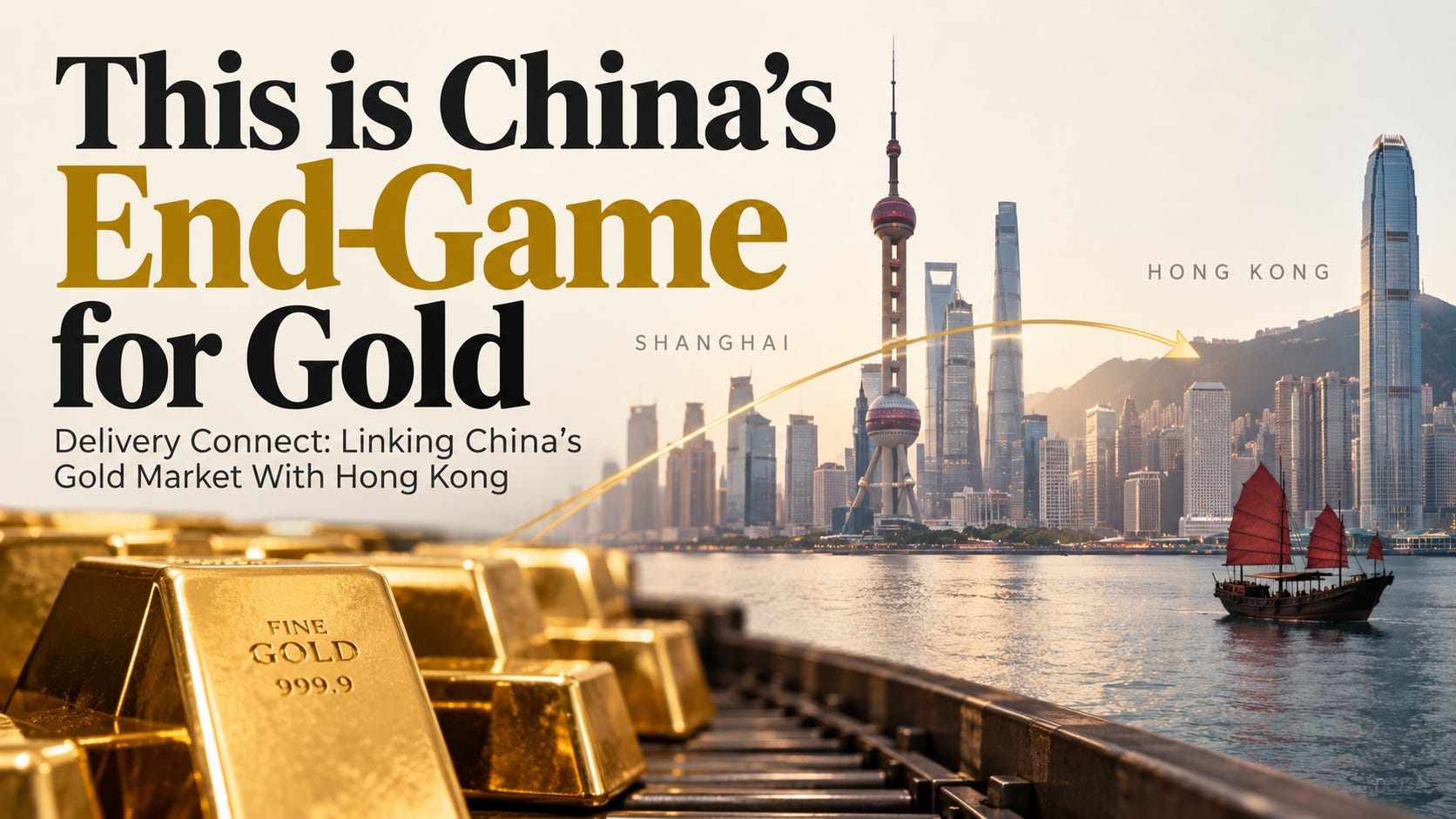
China’s Delivery Connect program links the Shanghai Gold Exchange with Hong Kong’s bullion infrastructure. It provides a channel for eligible participants to deliver, store and transfer physical gold between the mainland and Hong Kong.
Reuters Breakingviews describes Delivery Connect as a physical-delivery conduit modeled on China’s Stock Connect and Bond Connect programs. Those systems provide regulated links between mainland markets and international investors operating through Hong Kong. In reality, Delivery Connect is actually Gold (and soon Silver) Connect.
A Settlement Mechanism
A gold contract defines the price, quantity and settlement terms of a trade. Delivery Connect provides the infrastructure required to complete the physical portion of that transaction. It connects trading accounts, clearing institutions, approved vaults, bullion standards and delivery procedures across the mainland-Hong Kong border.
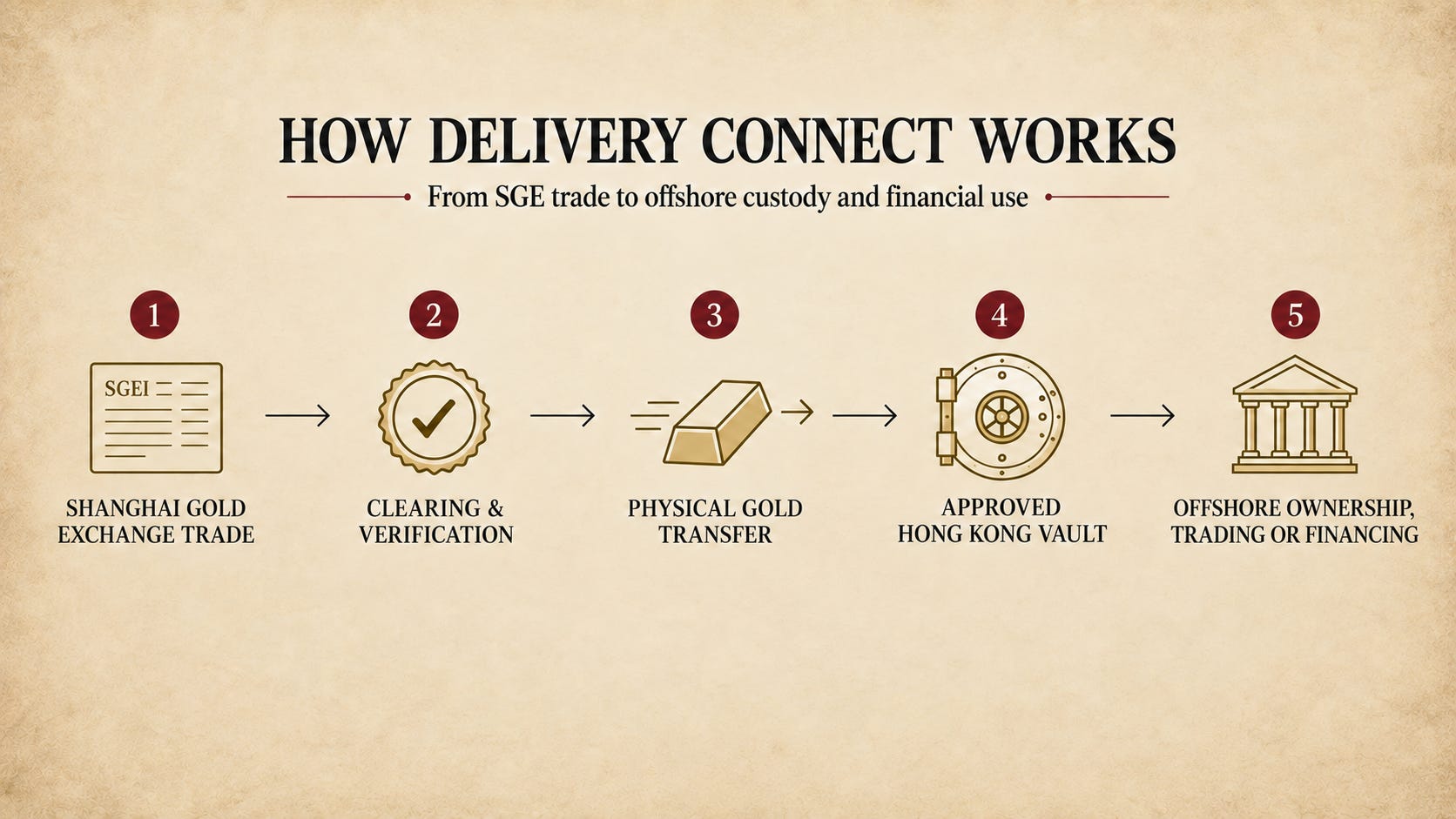
Eligible participants can trade gold through the Shanghai Gold Exchange or its international platform and settle the resulting obligation through connected facilities in Hong Kong. Ownership can be transferred through approved custody systems, while the metal can be stored or moved according to applicable delivery, assay and customs requirements.
The program reduces the operational separation between gold traded in Shanghai and gold held in Hong Kong. It will also support arbitrage between prices in Shanghai, Hong Kong and other international markets.
Hong Kong’s Function
China is the world’s largest gold producer and one of its largest consumers. Its domestic gold market, however, remains separated from international markets by capital controls and restrictions on bullion imports and exports.
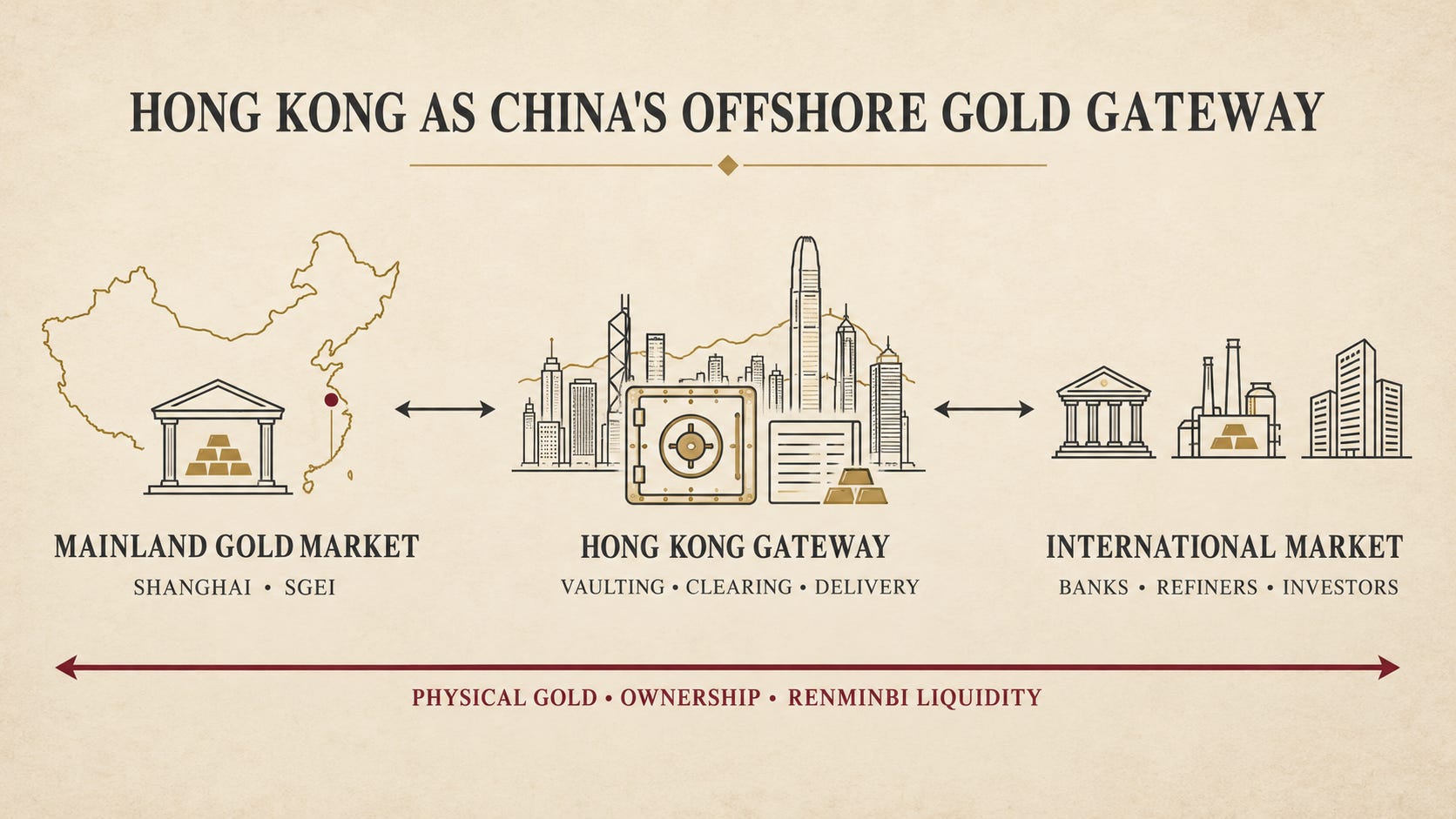
Hong Kong provides an offshore interface. It has an open capital account, an established banking system and a large pool of offshore renminbi liquidity. Its location also makes it suitable for connecting mainland trading with international custody and settlement.
Under this structure, Shanghai provides the domestic exchange and physical demand. Hong Kong provides offshore access, vaulting and financial services. Delivery Connect links the two systems.
The Gold-Market Structure
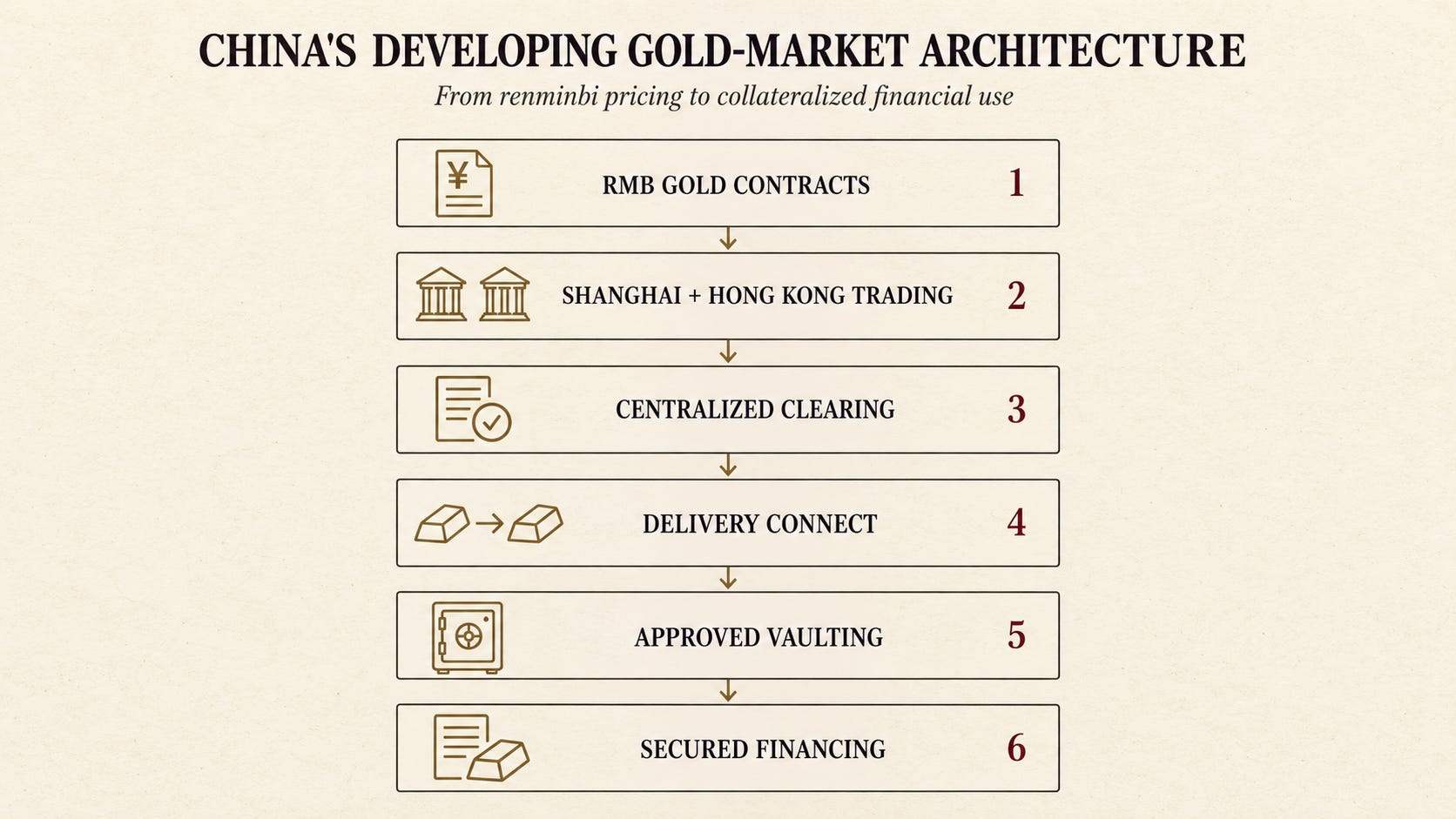
Delivery Connect forms part of Hong Kong’s broader plan to develop a gold-trading center. Other components include expanded bullion storage, centralized clearing and proposed gold-futures products, including contracts denominated in renminbi.
Together, these components create an integrated market structure:
Renminbi pricing → trading → clearing → physical delivery → custody → Repostyle financing
Each function is necessary for an institutional gold market. Participants require recognized bullion standards, secure custody, enforceable ownership rights, reliable settlement and the ability to transfer metal between accounts and jurisdictions.
Delivery Connect addresses the transfer and settlement component. It creates a process for converting a gold transaction into ownership of physical bullion across the mainland and Hong Kong systems.
Price Discovery
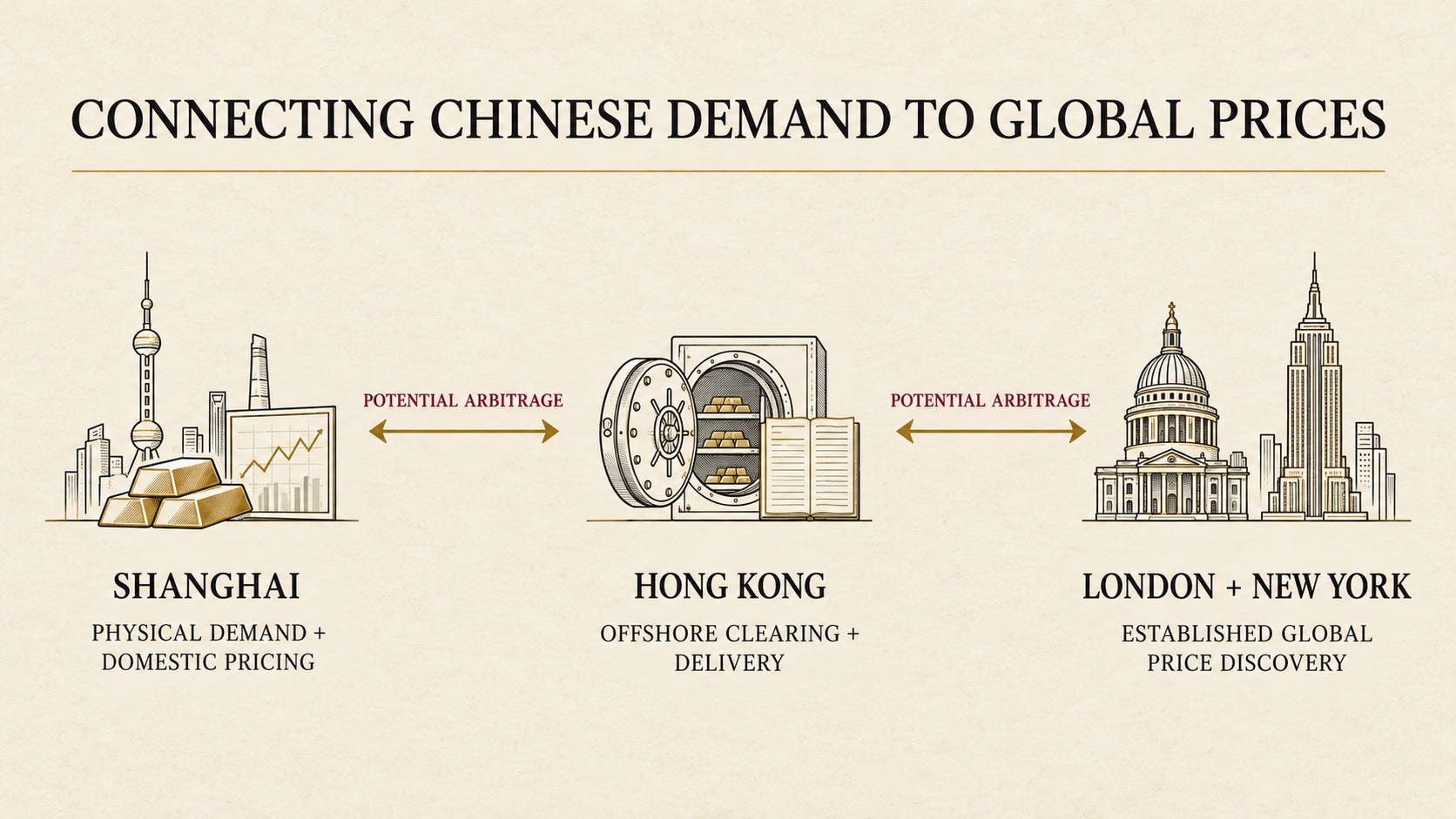
London and New York remain the main centers of global gold trading. London dominates over-the-counter bullion trading, while COMEX provides futures liquidity. Most international gold pricing, hedging and financing therefore operates through Western institutions and in US dollars.
China accounts for a large share of global physical demand, but its influence over international price formation has been limited by the separation of its domestic market.
Delivery Connect should narrow that separation. Easier movement between mainland and Hong Kong vaults can allow differences between Shanghai and international prices to be arbitraged more efficiently. Changes in Chinese physical demand could then pass into offshore prices more directly.
The effect will depend on trading volume, vault capacity, legal certainty and participation by banks, refiners and market makers. Infrastructure alone does not create liquidity. The system must attract enough activity to support consistent settlement and price formation.
Renminbi Internationalization
Delivery Connect also supports China’s efforts to increase the international use of the renminbi without removing mainland capital controls.
Gold can serve as a link between the renminbi and an internationally recognized reserve asset. Foreign institutions will definitely be more willing to hold or use renminbi when it can be deployed in a market offering physical gold settlement.
This does not make the renminbi gold-backed. Delivery Connect creates no general right to convert currency into gold and does not establish a fixed relationship between the two. It establishes market infrastructure through which renminbi-denominated gold transactions can be settled in physical metal.


China can therefore strengthen the commercial relationship between the renminbi and gold without adopting a formal gold standard.
Gold as Collateral
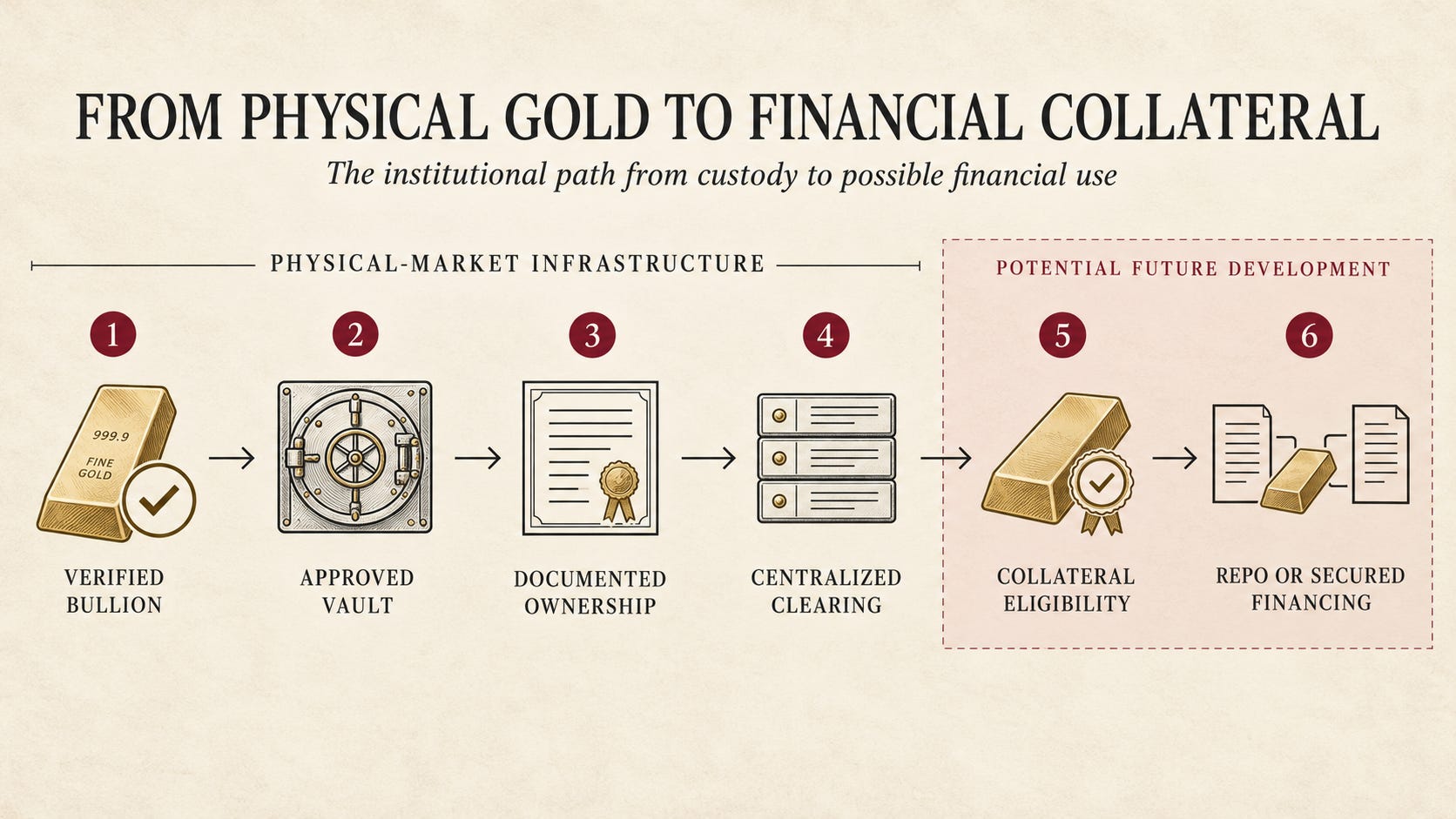
The system will also support the future use of gold as collateral.
Institutional collateral requires more than physical possession. Lenders must be able to confirm the gold’s location, ownership, quality and legal status. They also need a process for transferring or liquidating the asset if the borrower defaults.
Delivery Connect contributes to these requirements by linking custody and ownership transfer across the mainland and Hong Kong. Central clearing and expanded vaulting should support the later development of gold-backed repurchase agreements, margin arrangements and secured financing.
The program does not designate gold as high-quality liquid collateral and does not create a gold-repo market by itself. It provides some of the custody and settlement infrastructure such a market would require. If/When Gold in this foramt is HQLA andRepo eleigibleit would make a formidable challenge to the UST global dominance.
When you think of it, now we know what the US has been crowing that it has all its gold. This is coming soon.
Implications
Delivery Connect marks a change in China’s gold policy from accumulating and trading gold toward building financial infrastructure around it.
The immediate purpose is to improve physical settlement between Shanghai and Hong Kong. The broader purpose is to connect Chinese gold demand, offshore renminbi liquidity and international bullion markets.
London and New York retain advantages in liquidity, legal infrastructure and institutional participation. Delivery Connect does not remove those advantages. It gives China a regulated channel through which its domestic gold market can interact with the international financial system.
If Hong Kong develops sufficient storage, clearing capacity and market participation, the system will increase China’s influence over gold pricing and expand the use of renminbi in bullion transactions. It will also provide part of the infrastructure needed to use physical gold in secured financing.
Delivery Connect is therefore best understood as settlement infrastructure. Its significance lies in the functions that will likely be built upon it: renminbi pricing, international custody, physical settlement and, eventually, gold-based collateral markets.
China may have to re-think their policies on not letting gold leave the mainland. The fact that one can get physical deliver, although on the COMEX deliberately quite cumbersome, or more easily over the counter in London is what gives the West some pricing power. The Chinese may have to enable some gold to leave its shores even if it is via Hong Kong.
The reason is quite simple. Most of us have no more confidence in the Chinese Communist Party, than we do the CME Group, the LBMA, the federal reserve, or the Bank of England. You simply must be able to take physical deliver for any real credibility.
Increased use of renminbi in trade will require more renminbi. Demand strengthens the renminbi.
Increased use of renminbi results in less demand for dollars. Less demand weakens the dollar.
A stronger renminbi buys more gold. A weaker dollar implies higher gold prices (in dollars).
Nice little feedback loop to support gold?